




Air Apparent
By Mark Loehrke
Appears in the April 2026 issue.
Local air quality fights a failing grade
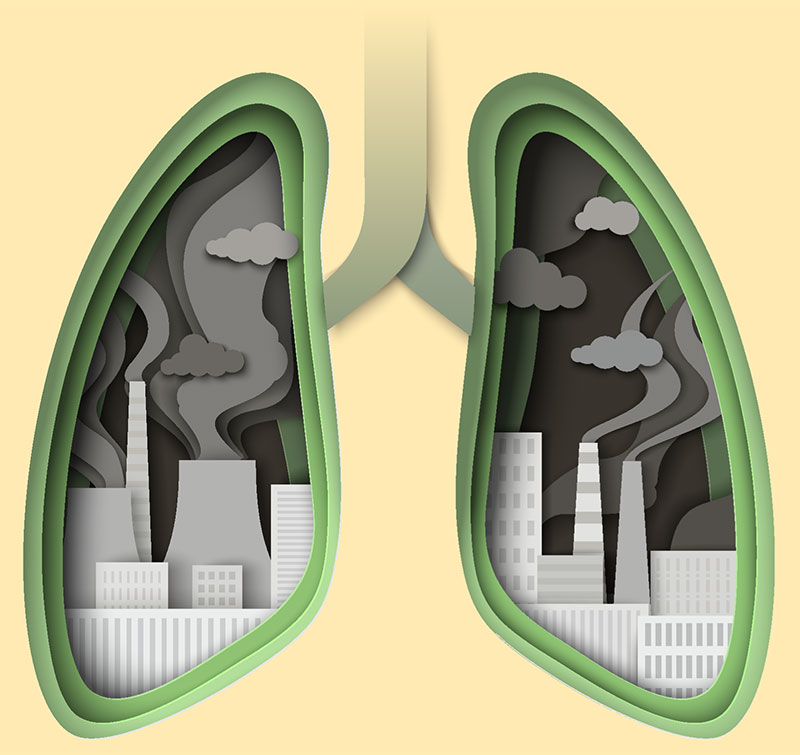
Nobody likes to see a dreaded F on their report card. Especially when the subject is the area’s air quality.
Unfortunately, that’s exactly where the greater Chicago-Naperville region scored in the 2025 State of the Air rankings from the American Lung Association. The grade was based on measurements over a three‑year period that counted how many days the metro area had elevated particle (PM2.5) and ozone pollution levels (see below), with the F reflecting 10 or more days with air pollution in the unhealthy range.
“When the Chicago–Naperville area receives an F for both particle pollution and ozone, it means the region experienced a high number of days when the air reached levels considered unhealthy to breathe,” explains Kristina Hamilton, director of advocacy for the American Lung Association in Illinois.
Specifically, Hamilton notes that persistently unhealthy air can contribute to an increase in the risk of asthma attacks, heart events, respiratory infections, and premature death for residents, as well as particularly higher risks for those in sensitive groups—such as children, older adults, pregnant women, and those with lung or heart conditions—who may need to limit outdoor activity on high‑pollution days.
Looking to clean up the region’s air quality, and thus boost that F grade, Hamilton says the American Lung Association is getting behind several initiatives and pieces of legislation, including measures that aim to limit the expansion of industrial pollution sources in overburdened communities, cut warehouse‑related pollution throughout the area, and modernize diesel emissions testing and close the medium‑duty vehicle gap to prevent pollution before it happens.
Even with progress in these areas, however, she says bringing up that F will take time and effort. But the end goals—better air and fewer breathing issues—are well worth it. “The region has significant work to do to reduce pollution from sources like traffic, industry, power generation, and wildfires—drivers that make these unhealthy days more frequent.”
Will the Chicago-Naperville area improve on its F grade? The American Lung Association’s 2026 State of the Air report will be released on April 22. For updates, check lung.org/research/sota.
* * *
Pitch In
Faced with a seemingly overwhelming issue like pollution, what can one person do to help clear the air? Here are some practical ideas.
• Use less energy in your home. Turn down the thermostat. Lower your water temperature. Make sure you have proper insulation. Turn off unused appliances and equipment. You’ll not only be helping to improve air quality and lessen greenhouse gas emissions—you’ll also probably save some money.
• Encourage your child’s school to reduce school bus emissions. Preventing buses from idling outside school buildings helps keep exhaust levels down.
• Seek out alternative transportation. Combining trips, choosing to walk or bike, and opting for buses or commuter trains means fewer cars on the road.
• Curb the burn. Burning firewood and trash create particle pollution.
• Use hand-powered or electric lawn care equipment. Old two-stroke gasoline-powered engines like lawnmowers and leaf blowers or snow blowers contribute to air pollution.
Source: American Lung Association
Double Trouble
The State of the Air rankings focus on two specific types of pollutants:
Particle pollution (PM2.5): Tiny particles that are small enough to be inhaled deep into the lungs and even enter the bloodstream. PM2.5 has been linked to asthma attacks and chronic bronchitis, increased emergency room visits, heart attacks and stroke, low birth weight and pregnancy complications, and premature death, especially among people with existing heart or lung disease. PM2.5 often spikes with traffic, industrial emissions, and increasingly, smoke from wildfires.
Ozone pollution (smog): Ozone forms in sunlight from vehicle exhaust and industrial emissions. It is a powerful lung irritant that can trigger asthma attacks and make breathing harder, reduce lung function (even in healthy adults), increase respiratory infections, and send children, older adults, and people with lung disease to the ER more frequently on high‑ozone days.
Illustration: iStock
