


Learn Something New
By Lisa Arnett
January 2026 View more Featured
Try a fresh activity and make connections this year with these local opportunities

This month’s aspirational “New year, new you” messaging tends to loom large. Instead of falling back on the tritest of New Year’s resolutions—hitting the gym, eating healthier—perhaps 2026 is the year you resolve to learn one new thing.
“How often as an adult do you learn something new?” says Colleen Loftus, who teaches American mahjong, a tabletop game that’s gaining popularity here in the west suburbs. “It’s scary to learn something new. It’s hard, it’s challenging, but the payoff, I think, is multifold for long into the future. With mahjong, you’re learning something you can play with your grandmother, you can play with your children, you can play with your spouse.”
Whether you’re interested in pursuing something creative, physical, or competitive, taking a class for beginners offers an opportunity to meet and interact with others in the community. Dana Walton of Walton Family Flowers, a micro flower farm in Bolingbrook, has found that to be the case when she teaches floral arranging workshops. “The flowers themselves provide a boost, but on a deeper level, it all comes down to connecting with other people, and that’s what we gain when we go to a class and we are sitting shoulder to shoulder with someone else in our community,” she says. “That’s a connection that can’t be duplicated.”
From golf to cooking to rock climbing, it’s not too late to learn a skill or craft that could become a lifelong pursuit or just a seasonal joy. Check out the people and places that are ready to help you get started.
Time to Tee Off
If you’ve always wanted to take up golfing, now’s the time: You can sign up for indoor lessons this winter and be ready to try out your swing on a course come spring.
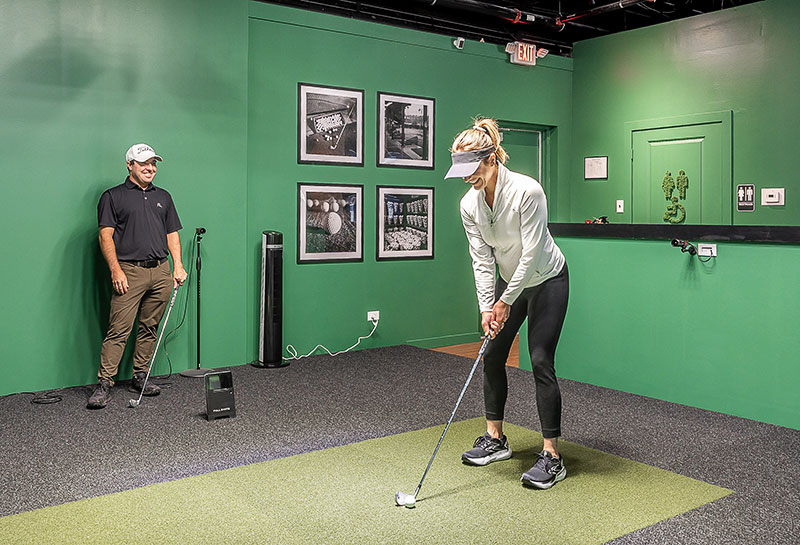
With the goal to offer indoor golfing sessions as well as lessons and leagues all year round, Naperville resident Tom Schaefer and longtime friend Andrew Shafer (similar names, no relation) opened Clubhouse540 (1466 E. Chicago Ave., Naperville, clubhouse540.com) last summer. The space features simulator bays equipped with Full Swing launch monitors that track your swing and shot and then offer up data to help you improve. “It’s the technology used in the first-ever iteration of professional indoor golf, TGL,” Schaefer says. Golfers of any experience level can reserve a bay for $50 an hour on weekdays and $60 on weekends. You also can book a private lesson with one of two golf pros onsite (starting at $100 an hour for adults).
“The technology is there for you to visualize how your swing is improving and you can track it over time: On Day 1, my swing speed is this, my ball flight is that,” Shafer says. “And we invested in these really extra-wide bays, so you feel like you are literally staring into a beautiful manicured golf course. The experience really feels true to life.”
Shafer thinks simulator golf is a great way for beginners to get a feel for the sport. “It’s less intimidating and it’s a great controlled environment to start to learn the game,” he says. “Another benefit is the time. You might say, ‘I don’t have five hours to go and play a round of golf.’ Here, you can play 18 holes in an hour, even [a simulated version of] Pebble Beach or some of these famous courses in an hour.” There are other practical perks too, Schaefer adds, “You’re never going to lose a golf ball. You’re not going to get a sunburn,” he says. “You’re not going to be pressured by the group behind you and you’re never going to be worried about keeping up with the group in front of you.”
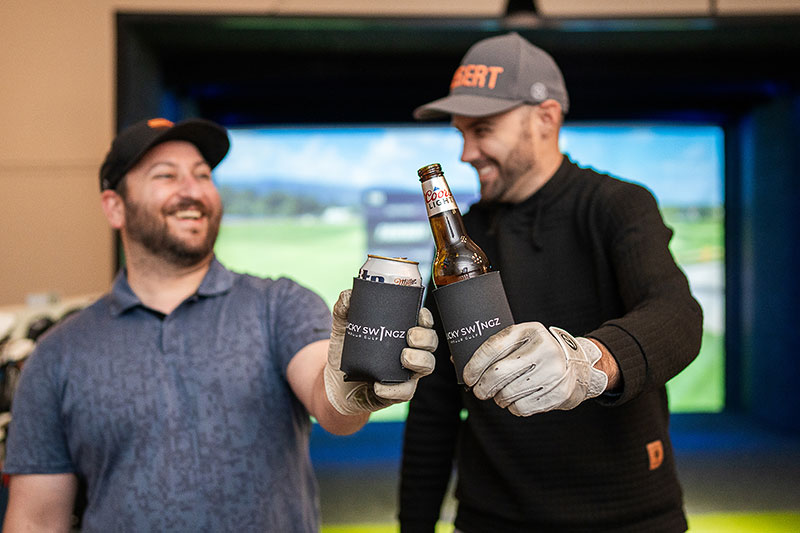
For a sip-and-swing experience, Clubhouse540 serves beer, wine, cocktails, and nonalcoholic options. Another indoor golf venue, Lucky Swingz (6200 River Bend Drive, Lisle, luckyswingz.com), is adding a full bar and kitchen onsite. It first opened its doors last April on the third floor of the West Suburban Sports Complex and also features Full Swing technology with extra-wide bays. “It really provides the most accurate experience in simulated golf,” says Kendra Petti, director of operations.
At Lucky Swingz, golfers can reserve a bay for $50 an hour or buy into prepaid membership packages that bring rates down as low as $31.25 an hour. Private lessons run $100 to $150 an hour. “It can be pretty expensive to acquire the equipment to golf,” Petti says. “So we also have a number of great-quality rental set clubs for any beginners who aren’t ready to buy their first set of clubs.”
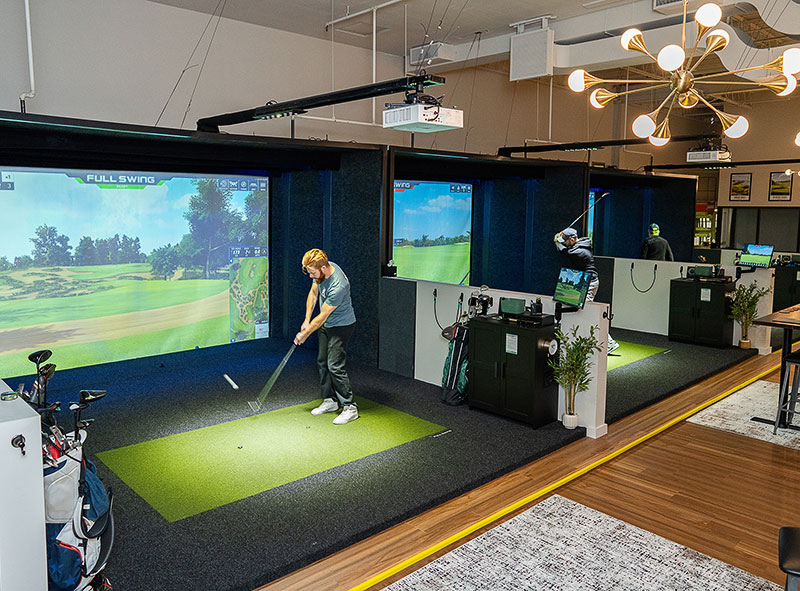
Petti enjoys seeing newcomers find their passion in the sport. “It just really provides a mental escape from the real world and allows you to focus on something kinesthetic for a short amount of time,” she says. “Golf is a sport that almost everyone can get involved in at any age. In the wintertime, a lot of people are stuck at home…and here, you can book a weekly tee time and do something active and social at the same time.”
Game On
American mahjong is having a moment. Whether it’s Meghan Markle playing with friends on her Netflix show or social media stars Kim and Penn Holderness singing about it to the tune of Sisqo’s “The Thong Song,” the game is everywhere you look.
One of the instructors teaching this complex and addictive game to west-suburban newbies is Geneva resident Lisa Oleson of Blue Tiger Mahj Club (formerly called The Mahjong Guild). Her Mahj 101 classes ($75 to $100, bluetigermahjclub.com) hosted at local venues such as Harvey’s Tales in Geneva, Park & Oak in Glen Ellyn, and Tierra Distilling Co. in Clarendon Hills consistently sell out, and she’s booked up months in advance for private lessons.
The tile-based game dates back to 19th-century China and now has dozens of variations, including Hong Kong–style mahjong, riichi mahjong, and American mahjong. While living as an American expat in Singapore, Oleson learned to play Singaporean mahjong. “It was a lovely way to connect with the culture and also grow my friendship circle in a new place where I didn’t know anyone,” she says.
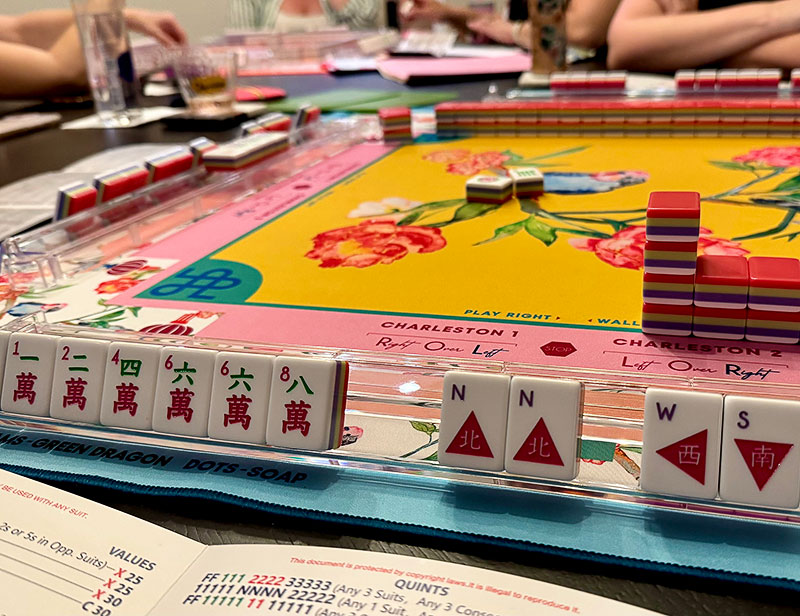
When she returned to the States, Oleson discovered American mahjong and started teaching family members and friends. “When mahjong first came to the U.S., it was a translation of the Chinese game and players started to make their own house rules,” she says. The game became popular in Jewish communities, and in 1937, a group of Jewish women founded the National Mah Jongg League in New York City to standardize rules for the Americanized version of the game. What makes American mahjong different from other variants is the use of NMJL’s card, which details what groupings of tiles (called hands, like in a card game) players can assemble to win. With the patience and enthusiasm of a kindergarten teacher (her bachelor’s degree is in elementary education), Oleson teaches the vocabulary and rules of American mahjong and helps decode the NMJL card, which can be dizzying and daunting for newcomers.

“I think we’re seeing a renaissance of [American mahjong] right now for a multitude of reasons,” Oleson says. “We are all discovering that it’s worthwhile to spend quality time with one another and get off of our devices and focus our brain on something that’s challenging…You really have to be present while you’re playing the game; you can’t be surfing on your phone.” To give her students more opportunities to play, Oleson is starting a weekly social league in 2026, running Monday nights from Jan. 5 to Feb. 9 at The Cottage in Wheaton. If it’s well attended, she hopes to continue it seasonally.
Downers Grove resident Colleen Loftus started playing American mahjong in 2021. “At the time, my kiddos were getting ready to go to college…and I wanted an excuse to get together with friends,” she says. “I thought, what are opportunities for us to get together and socialize and use our brains, and I was really taken with the idea of mahjong and how our grandmas used to get together and play a game of cards with the neighbors.”
Having worked as substitute teacher, Loftus felt comfortable teaching her friends how to play, and there was so much interest in the game locally that she launched her own teaching business, Mariposa Mahjong. She teaches private lessons as well as beginner group lessons ($45) at breweries such as Alter in Downers Grove and Bubblehouse Brewing in Lisle, and also offers guided play sessions ($25) over coffee at cafés such as Roasted Elements in Downers Grove. “When I teach, I tell people that the first hour of the lesson is going to feel like walking through mud,” she says. “You’ll be overwhelmed and think, ‘I can’t learn this.’ Around the second half of the lesson, parts of it will start to click.” She’s also working on organizing a beginner-friendly league in early 2026.
Another force behind American mahjong’s recent popularity is a boom of manufacturers making tile sets, table mats, and tablecloths that make curating a mahjong tablescape a hobby in itself. (One maker, My Fair Mahjong, summed up the phenomenon perfectly in a social media post that read: “Mahjong is a harmless cult with very cute accessories.”) At her lessons, Loftus uses sets from Oh My Mahjong, a Dallas, Texas–based brand known for its colorful and whimsical designs. “I equate it to jewelry—it’s just something beautiful to look at and it gives me joy…and I think it just brings more people to the game,” she says. “What I love specifically about Oh My Mahjong is that their designer [Anna Nguyen] is a woman of Asian descent, and she makes sure their designs pay homage to the original tiles. I personally feel like being culturally reverent to the origins is important.”
In contrast with other parlor games such as Bunco—a dice game of pure luck—or chess, which requires strategy and skill, mahjong combines all three. “It’s luck, strategy, and skill,” Loftus says. “And I think that’s what makes it so appealing in many ways.”
Flower Power
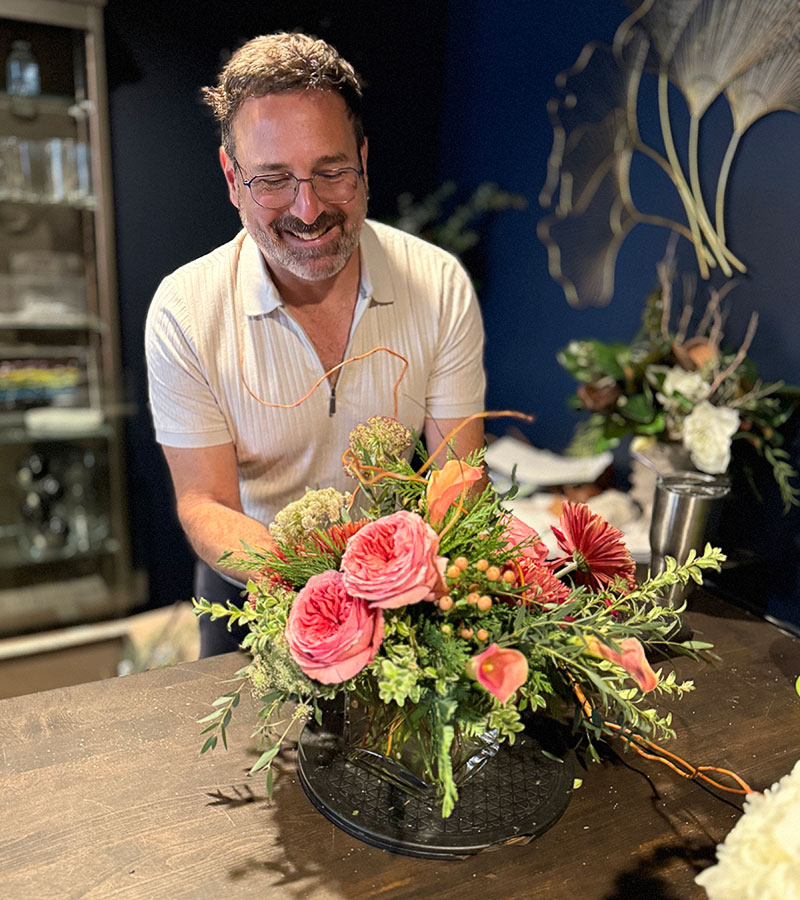
During floral arranging classes at 6th & Foster (571 W. Liberty Drive, Wheaton, 6thandfoster.com), co-owner Andrew Parravano loves watching students go from hesitant to confident. “At the start of the class, we have an example of what we are going to create, and everyone’s reaction is, “Oh, I can’t do that,’ ” he says. “And by the end, they have created something that is beautiful and an expression of themselves.”
Parravano studied ornamental horticulture and landscape design and operated Andrew’s Garden Floral Couture in Wheaton for 10 years before opening 6th & Foster in October with Doug Bates, a floral designer formerly based in Michigan. Bates’s industry cred includes certification with the American Institute of Floral Designers and gigs designing for the Tournament of Roses Parade and New York Botanical Garden’s Orchid Dinner.
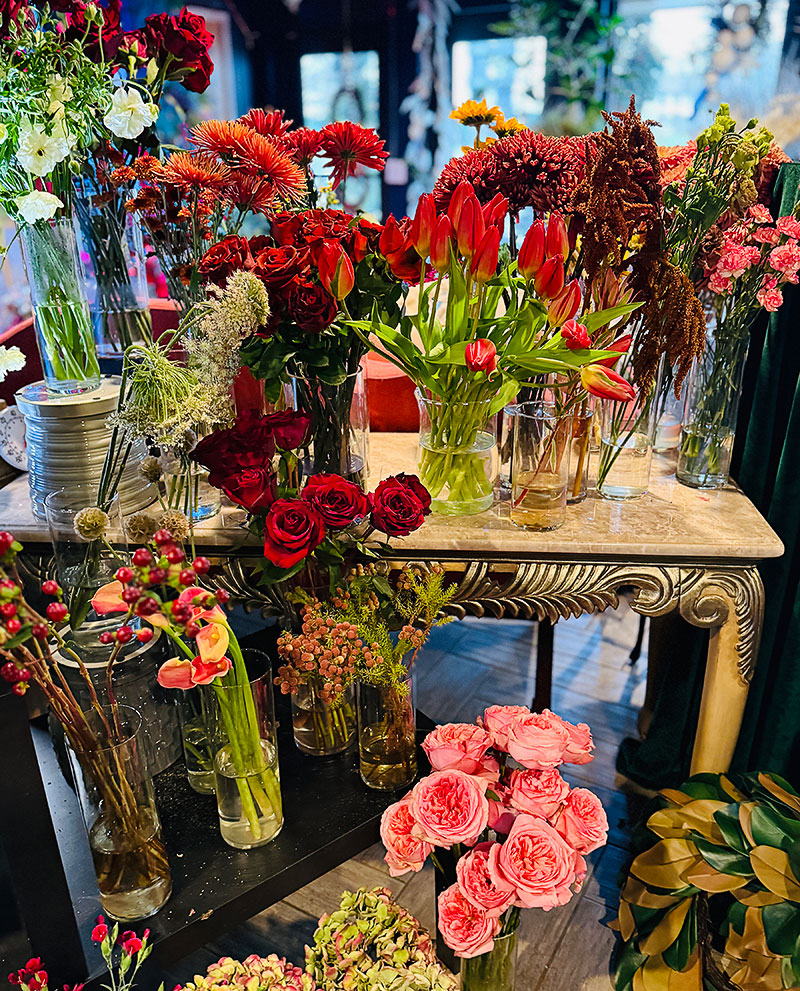
During each hands-on class, Parravano and Bates teach principles of floral design such as line, texture, color, and movement. “And then you’ll learn how to be creative with those principles, so you don’t lock yourself into something that’s formulaic,” Parravano says. “We teach the technique, but the end result is always an expression of who the person is, and that I absolutely love.” Classes start at $125, and students go home with a fully finished arrangement or centerpiece. “We love giving people an ability to express themselves in an artistic manner,” Parravano says. “Being able to create something at the end of an hour and a half and look at it and go, ‘I created that!’—I mean, that just fills somebody’s soul.”
You’ll also find more casual bouquet-making sessions nearby thanks to other locals who have found their calling in floral arranging. “Flowers really found me when I was in that dark, kind of metaphorical January winter of my life, postpartum and home with young kids for the first time after working full time,” says Dana Walton of Walton Family Flowers in Bolingbrook (waltonfamilyflowers.com). “I was constantly drawn to going outside with my kids, and we just moved into a house where there were lots of perennial flowers, so I started cutting them and bringing them inside. I loved doing something creative with my hands that involved nature, and it evolved to the point where I said, ‘I think I should be doing this as a business.’ ” She started selling bouquets at the Aurora Farmers Market and has hosted casual workshops ($30 and up) at local venues such as MOTW Coffee and George & Fred in Naperville.
For Lara McDonald, a floral designer and lifelong Napervillian, working with blooms marks a return to her roots. “My grandparents operated a big floral shop with massive greenhouses in Indianapolis, and I kind of feel like it’s in my blood,” she says. After a 15-year career in graphic design, she launched Ella E. Modern Vintage (ellaemodernvintage.com), a boutique floral and handmade jewelry business. She hosts floral workshops (typically $55 to $75) at Faherty in Naperville as well as Trend & Relic in St. Charles, where she also sells her jewelry line. “I talk about texture and size and color and height, but at the end of the class I do point out, look around and every single person’s arrangement looks different, but everyone’s looks great,” she says.
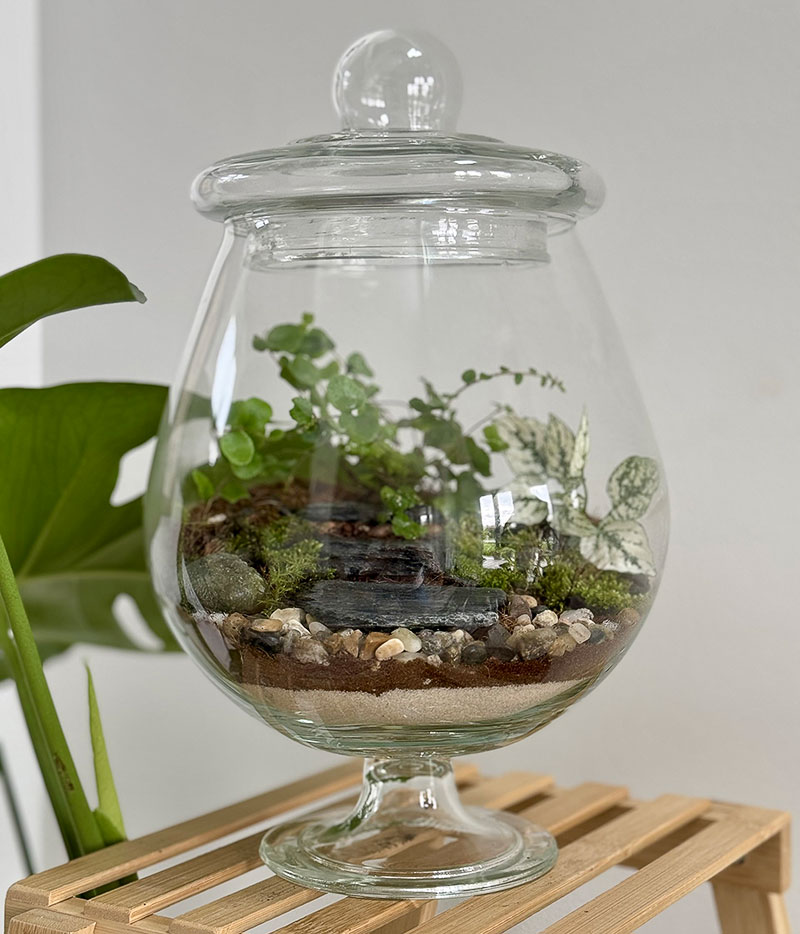
For longer-lasting greenery, Tonya Thethi teaches terrarium making at her plant boutique Fern, which opened last August (1001A Curtis St., Downers Grove, fern-dg.com). “A terrarium is a mini landscape of plants enclosed in a glass vessel,” Thethi says. “With all the proper elements, it will act as a mini ecosystem by creating rainwater and becoming completely self-sufficient.” Workshops cost $60 per person, or you can visit the shop’s DIY terrarium bar Wednesday through Sundays (vessels range from $28 to $50). “I have to say, everyone is always smiling and enjoying themselves when they create these,” she says. “Putting your hands in dirt and building something naturally boosts your serotonin. Serotonin is basically your happiness hormone. Plants equal happiness.”
Good Enough to Eat
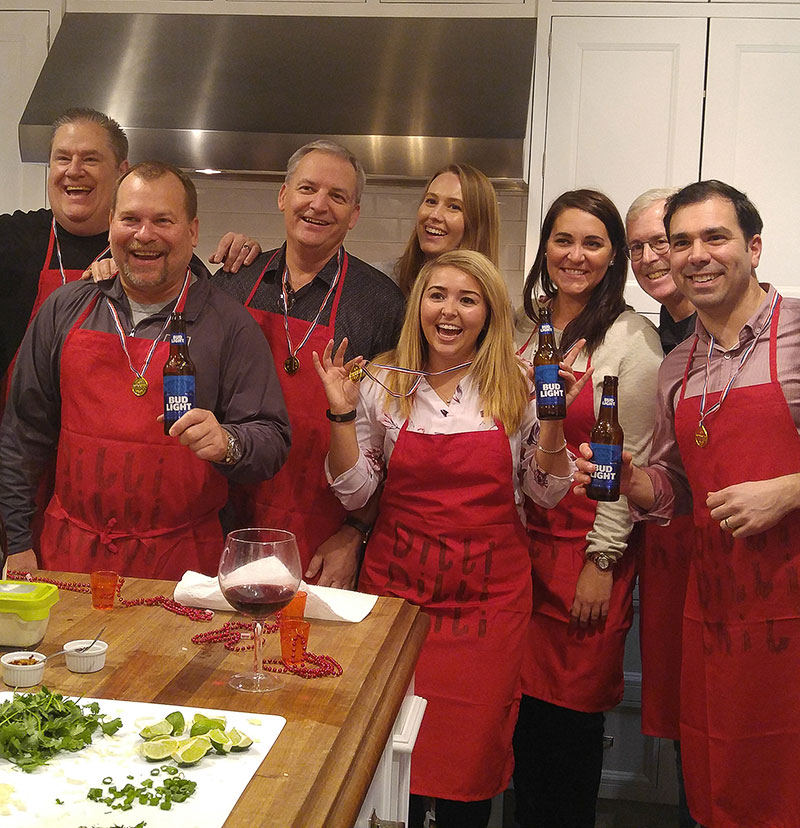
Third-generation organic farmer and lifelong Naperville resident Veronica Porter grew up immersed in farm-to-table dining before it became a buzzy catchphrase. “My mother cooked all our food, and my father grew all our food, and their entire philosophy was, how and where your food is grown matters,” she says.
Porter has found her passion in culinary education and has taught cooking classes through her business, Ask Aunt V (askauntv.com) since 2014. She studied at the Culinary Institute of America and earned a master’s degree in organic farming and urban farming through University of Illinois at Urbana-Champaign. “My motto is from the garden to the table, from the classroom to the community,” she says. Her small-group classes at Liam Brex (222 S. Main St., Naperville) are open to the public throughout the year and typically cost $95 per person. “We like to focus on classes of six to eight people so everyone can gather around the island,” she says. Class themes range from comfort food classics to sushi basics, and seasonal offerings might include Irish soda bread for St. Patrick’s Day, grilling skewers for the Fourth of July, and football tailgate food in the fall.
No matter the cuisine, Porter emphasizes how to cook with what’s available seasonally in the Midwest, which reaps the best flavors and prices. “It’s important for me to teach people the importance of how and where your food is grown,” she says. “I talk all about how to pick the perfect produce and…how to cut it, and if they can’t use it all, the proper way to preserve it and how long it’s safe to keep it,” she says. “With the understanding that we’re busy people, just getting anything on the table is hard. I want to help people realize that with the right knowledge, they can do it.”
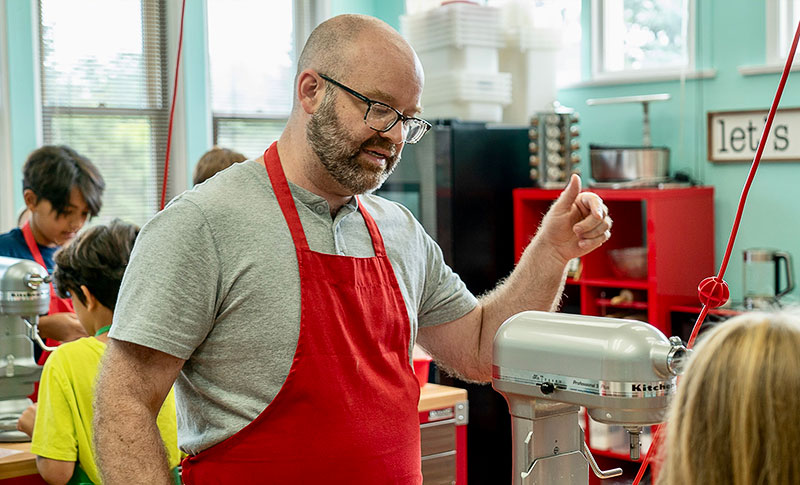
Wanting to level-up your cooking skills in adulthood is a noble goal—and it’s a notion that former elementary and middle school teacher Aaron O’Brien especially relates to. He and his wife, Amy, operate The Kitchen Table (100 Hahndorf St., West Chicago, thekitchentablewc.com), a casual cooking school for all ages in a former 1920s schoolhouse off Route 59. “I didn’t learn how to cook until after Amy and I got married,” he says. “On our first date…we made pizza at her parents’ house, and it was great. Years later after we got married, I was like, “Honey, how come you don’t make pizza as often as you used to?’ And she said, ‘Well, you know the recipe.’ I thought, ‘That’s fair.’ ”
Amy’s not-so-subtle dig sent Aaron on a journey of culinary self-discovery through books, TV shows, and experiments in the kitchen. With four children of their own at home, they decided to start a summer cooking camp for kids, and that evolved into the full-time school they operate now. “We saw that there were places to take class that were very gourmet and expensive, but we were interested in starting something that was more affordable and that you would repeat at home,” Amy says. They offer group classes for adults as well as private lessons. “One time I did a two-hour class of just general cooking for someone who was just going off to college,” Aaron says. “We focused on the basics of cooking and incorporated knife skills and made a couple different dishes.” The O’Briens also offer seasonal events that spotlight a specific menu item. “For Thanksgiving, we set up apple pie stations, so you make the filling, you make the crust, you put it together and then you get to bring it home and bake it,” Amy says.
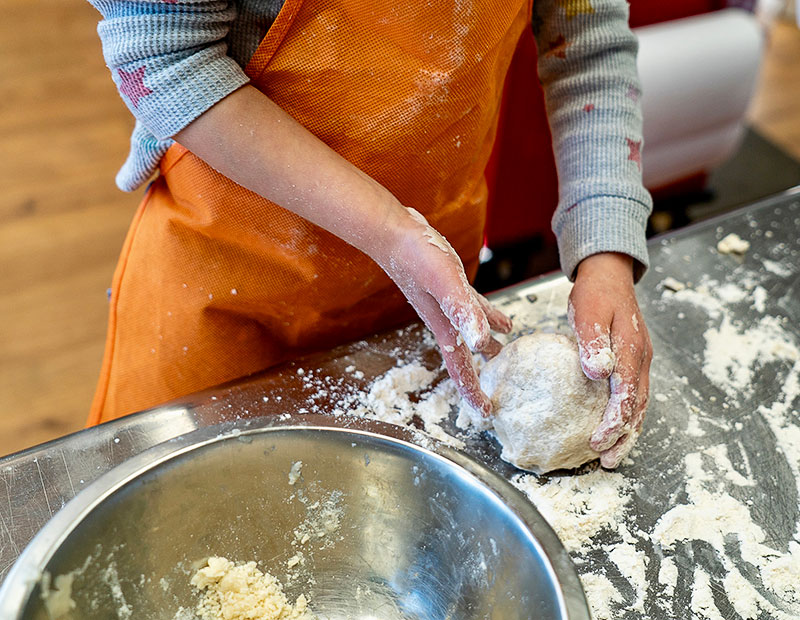
The O’Briens can accommodate allergies, religious dietary restrictions, and sensory needs. “We try to make it a place where everyone is welcome and participates,” Amy says. “We have headphones, we have gloves, we have different things to help with any sensory issues people may have with food, and we try to make it fun to learn new things.”
Developing your skills in the kitchen is an investment that can pay off every day of the week. “Sometimes starting a new hobby as an adult is harder to make time for if you have a family and a busy job,” Amy says. “For me personally, I love killing two birds with one stone, and cooking as a hobby can fit into your life because it fulfills a basic need, and it can bring people together.”
From Great Heights
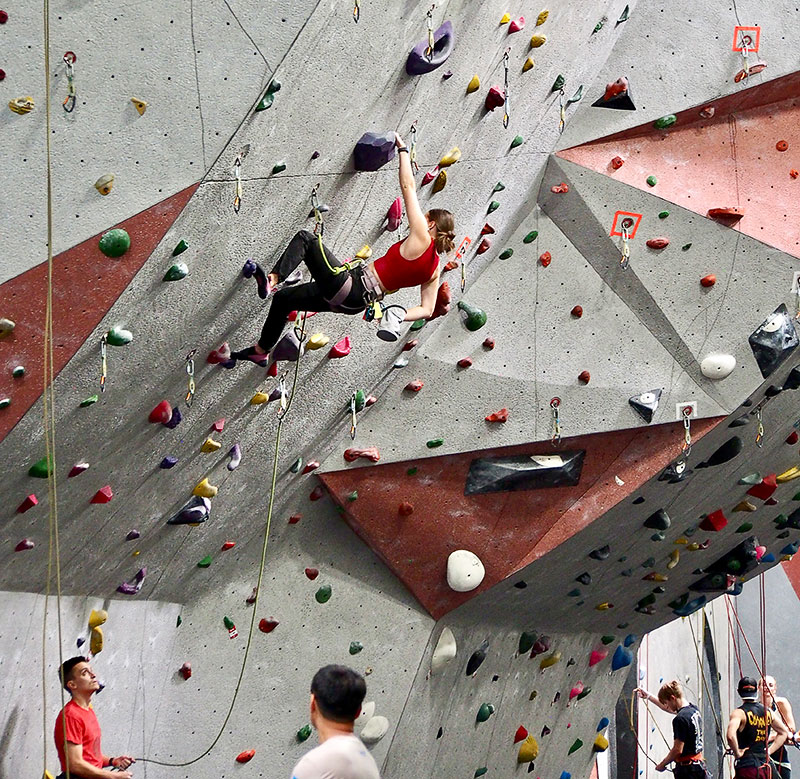
John Cartozian had never tried indoor rock climbing before when a friend invited him along in 2006 as a recent high school grad. “It’s mentally engaging and physically engaging, and after trying it just once I felt like I had figured out what I wanted to do for the rest of my life,” says Cartozian, now the facility manager at Vertical Endeavors (246 Windy Point Drive, Glendale Heights, verticalendeavors.com).
“Climbing does take physical strength to do, but it’s even more so a mental game,” Cartozian says. “Some of the initial mental obstacles are fear of heights, fear of falling, being insecure in a precarious position. It definitely starts helping you hone those skills of being more in control of any perceived fear you might have.”
When Vertical Endeavors opened in Glendale Heights in 2014, it was the largest climbing facility in the country, and it remains one of the largest today. “The walls are not super tall—the max is about 32 feet—so it’s not overly intimidating but still tall enough. We have sections of wall that you can continuously climb for 110 feet,” Cartozian says.
The gym is equipped with 35 automatic belay systems. “It’s essentially a rope and the main mechanism is behind the wall and allows you to simply clip in and climb,” Cartozian says. “It lowers you down to the ground at a controlled descent. I like to say for anybody who is a little hesitant, it’s like taking a pretty slow elevator down versus a giant drop.” After going through orientation with a staff member, you can clip into an auto belay and give climbing a go.
After trying auto belaying, you could move on to learn how to use top ropes. “A rope has two sides and it’s strung through an anchor at the top of the wall. In our basic top ropes class, you’ll learn belay skills with a partner and after that, you can utilize more of our facility,” Cartozian says. Bouldering—climbing at lower heights without a rope harness—is also an option here. “That’s another form of climbing that you can do with little to no experience,” he says.
Cartozian and his team also offer private lessons and a class on sport lead climbing that helps bridge the gap between indoors and outdoors. “We also offer top rope anchors classes at Devil’s Lake State Park in Wisconsin where you can learn how to set up your own ropes so you can start going outside,” he says. “We’ve had people take that class multiple times just because they wanted that added instruction.”
Inclusivity is important at Vertical Endeavors, and though the walls may look intimidating at first, Cartozian welcomes newcomers to give it a try. “You can be any body type; you can be any age. The beautiful thing about this sport is that we have had members pushing their 90s on our wall and coming pretty regularly,” Cartozian says. “It is also kind of a low-impact sport. We have people come in rehabilitating from having hip injuries, leg injuries, or rotator cuff injuries, and it’s still something you can do.”
Looking for more places to climb? The last Friday of every month, Warrenville health club Life Time (28141 Diehl Road, lifetime.life) offers adult climbing classes for members ($15). “I think it’s an excellent opportunity for adults to focus on a single task and sharpen your problem-solving skills,” says Amy Schmidt, kids leader at the club. “It’s a great full body workout, and you will feel it in your shoulders, your fingers, and your legs.”

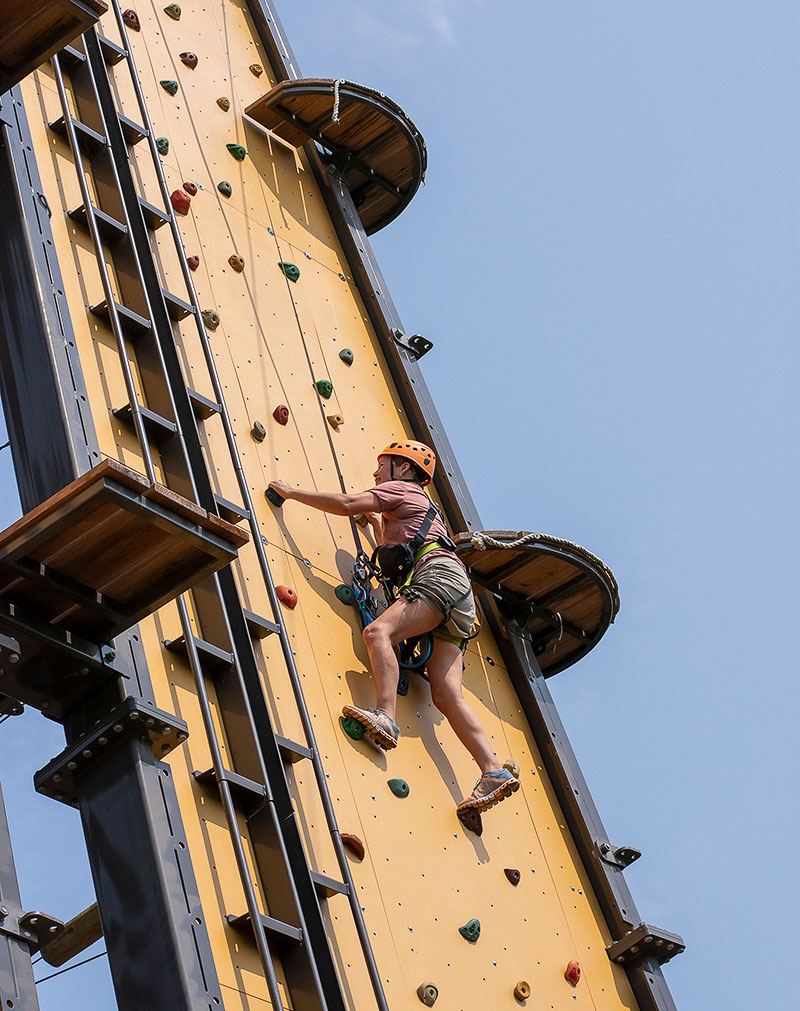
The high ropes course and 90-foot climbing tower at The Forge (227 Heritage Quarries Drive, Lemont, forgeparks.com) also reopen for the season in April. “The way it’s structured, it’s really accessible for all different levels,” says Brad Donati, general manager. “Once you go through the safety briefing and learn our clip system, you can pick and choose what areas you want to go to. You’re connected to your belay cables the whole time and you are very secure.” There’s also a bouldering option to climb closer to the ground without a harness or ropes. Pricing is $80 per person for ages 14 and up. “We are a playground for people to come experience things for the first time,” Donati says. “Maybe this gives them the courage to actually go climb something bigger or hike a mountain somewhere.”
Photos: Jennifer Echiburú (Lucky Swingz); InCasa (Clubhouse540); Lisa Arnett (American mahjong); Blue Tiger Mahj Club; Jen Banowetz (6th & Foster); Fern; Ask Aunt V; The Kitchen Table; Vertical Endeavors; The Forge
