



Working Together
By Mark Loehrke
Appears in the June 2026 issue.
Tackling Parkinson’s as a team
After working with people with Parkinson’s disease in a multidisciplinary movement disorders clinic for more than a decade, Erica Fenton saw what she believed to be the same systemic issue holding her patients back time and time again.
“The health care system is built for reaction, not prevention,” she says. “When I looked at what existed, I found two gaps: no meaningful bridge from diagnosis to maintenance habits, and therapy options so siloed that accessing all of them would require a full-time logistical effort.”
So Fenton decided to do something about it. Drawing on both her professional expertise and her personal experience of using intentional movement to recover from a serious car accident in her teens, she started the nonprofit m.o.v.e. Foundation (movefound.org) in spring 2025. Focused largely on helping individuals recently diagnosed with Parkinson’s build strength and resilience through volitional movement patterns (the acronym stands for multimodal, overexaggerated, volitional exercise), the program is also about providing support through community. “Our goal is to equip individuals and their families to live with volition from the very beginning,” Fenton explains. “We believe no one should wander through the first 10 years of their diagnosis alone, without the knowledge and tools that could have made all the difference.”
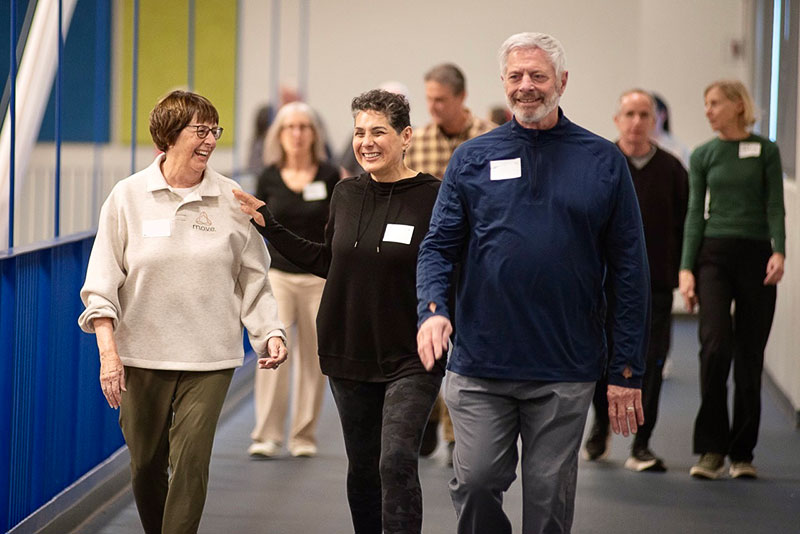
The core m.o.v.e. program is a nine-session, 90-minute boot camp that the group offers three times a year at Madison Meadows Athletic Center in Lombard (the last program for 2026 will be in October.) Fenton says each session targets every area that Parkinson’s touches—voice, swallowing, cognition, balance, coordination, fine motor function, and emotional well-being—all while participants get their recommended 150 weekly minutes of exercise.
Delivering these sessions is a team of specialists in speech-language pathology, occupational therapy, physical therapy, and social work—all operating in the same space at the same time. This kind of coordination and cooperation is what Fenton believes fills the gap that long existed in the fragmented world of Parkinson’s treatment. “Our disciplines don’t just coexist, they work together in real time to address the whole person,” she explains. “As we like to say, ‘Every part, from the start.’”
Also key, Fenton says, is that m.o.v.e. is designed for support systems, not just participants. Families, care partners, and loved ones are part of the experience from the beginning—and all become part of a community that continues to receive free educational content and support long after the bootcamp ends. And, crucially, m.o.v.e. programs are entirely free for participants and their families, thanks to donations the foundation receives from businesses, individuals, and sponsors throughout the community.
As for the benefits participants receive, Fenton says they go far beyond the boot camp sessions themselves. Many alumni describe feeling like they got themselves back, from one individual who came in able to manage two stairs and left doing a full flight to another who said she started reengaging in social activities because she had more confidence in her voice. And almost every participant walks away with a more thorough view of their condition, thanks to the program’s simultaneous focus on both education and movement. “No other program offers that depth of disease education layered directly into functional exercise,” Fenton says. “And our participants tell us all the time what a difference this makes.”
Fenton and her team are building on their early momentum. “M.o.v.e. is just over a year old, and we’re proud of how much ground we’ve covered, but we’re just getting started,” Fenton says. “Because progressive neurological disease doesn’t wait, the health care system wasn’t built to meet it early enough or often enough, and no one in this community should spend the first decade of their diagnosis without the knowledge, the tools, and the people that could change everything.”
Photo: Nick Duncan Photography/m.o.v.e. Foundation
