



Aim High
By Naperville Magazine
Appears in the April 2026 issue.
By Jeff Banowetz
Take some time to admire Chicago’s spectacular architecture
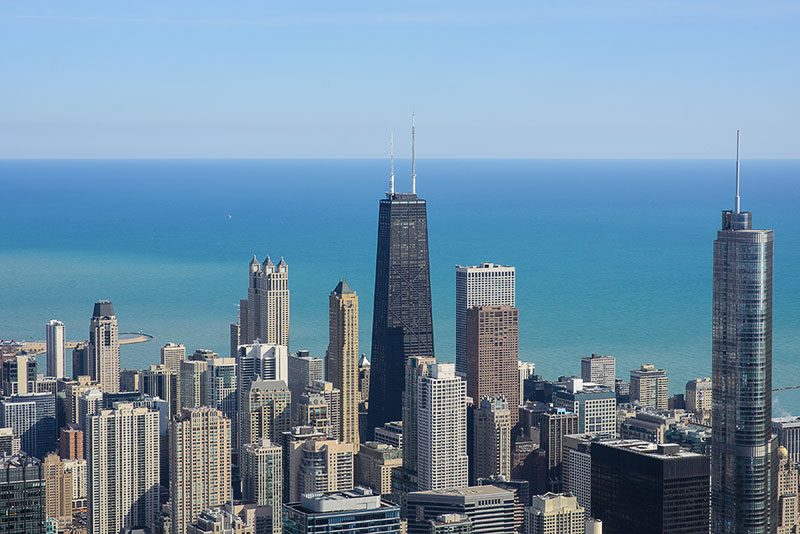
Living and working in the Chicago area gives someone a basic understanding of the city’s architectural heritage. You can identify the major buildings—like the Hancock Center and Sears Tower—even if their names have changed. But as a local rather than a tourist, you might be less likely to dig deeper into the history and splendor to be found in one of the world’s most architecturally diverse and adventurous cities. That’s a shame, but it’s also easily remedied.
There are a variety of ways to get a better understanding of Chicago’s architectural culture, including tours organized by the Chicago Architecture Center, a nonprofit “devoted to celebrating and promoting Chicago as a center of architectural innovation.”
If you’re lucky, that tour may be led by Ellen Shubart.

Shubart is a volunteer docent for the organization who has led walking, bus, and river-cruise architectural tours for years. She’s also the author of Chicago’s Greatest Buildings: Skyscrapers, Landmarks and Hidden Gems in the City of Architecture, a recently released book that delves into 82 of Chicago’s most significant buildings.
Shubart started her career as a teacher and then a journalist, but in 2000 she returned to school (at the Art Institute) to earn a degree in historical preservation. While she officially “retired” from full-time work in 2006, she’s spent the last two decades promoting and chronicling architectural gems throughout the Chicago area.

“I don’t believe that retirement means you stay home,” Shubart says. “It’s a wonderful thing to do—to meet people and show them this phenomenal city. The Chicago Architecture Center is a philanthropic organization, so the money it raises from these tours is used to educate kids about the city and urban planning. So for me, it’s a combination of doing something for good as well as having a good time doing it.”
Part of the appeal of Chicago’s architecture is its variety. “We pretty much have every American style that you can imagine, with the exception of the early Federal stuff, because Chicago didn’t exist then,” Shubart says. “Chicago is wonderful because it didn’t get rid of all its older buildings to put up new and beautiful buildings. Yes, some of them disappeared, but many are still here. They’re either adaptively reused, or they’re still being used for their original purpose.”
For a better understanding, start at the Chicago Architecture Center, 111 E. Wacker Drive, which features a scale replica of the city with 4,250 model buildings. It also offers more than 80 tour options that highlight various areas of the city by different means of transportation (see sidebar, below).
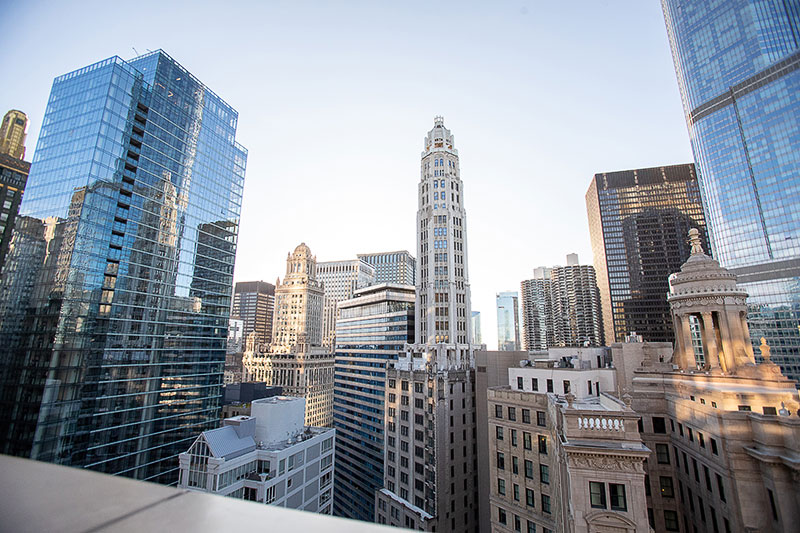
New this year is the Introduction to Chicago tour, which highlights the evolution of architecture in the city with an hour-and-45-minute tour of downtown sites. It will include buildings featuring classically inspired European styles, American art deco, modernism, and contemporary designs. “It highlights all these styles of buildings and how they’ve come and gone,” Shubart says. “It will give you an understanding of the evolution of the city.”
River tours are the most popular option, especially during the summer months. “You get a unique view of the buildings and all the narration without having to walk from place to place,” Shubart says. “And honestly, it’s just enjoyable to spend a beautiful day on the river.”
Of course, exploring on your own is a possibility as well. Choose Chicago (choosechicago.com), the city’s tourism office, offers sample itineraries for walking tours.

For a bird’s-eye view, consider two of Chicago’s most popular attractions—observation decks at the city’s tallest buildings. Skydeck Chicago at Willis Tower (formerly Sears Tower, 233 S. Wacker Drive) is located on the 103rd floor with 360-degree views of the city. Step out onto The Ledge, a glass box that extends from the building, and you can look 1,353 feet straight down. At 875 N. Michigan Ave. (formerly the Hancock Center), you’ll find 360 Chicago, the observation deck on the 94th floor.
Those interested in exploring architecture at ground level may consider diving into a particular architect or style, such as art deco, Frank Lloyd Wright, or a modern favorite like Jeanne Gang. “People come downtown and want to see Frank Lloyd Wright, and they have to visit the neighborhoods or Oak Park to see most of his work,” Shubart says. “But you can see the lobby of The Rookery (209 S. LaSalle Street), which is remarkable.”

If you haven’t taken a tour in a few years, you also may be surprised at the number of impressive modern buildings that now dot the skyline. Gang’s design firm, Gang Studios, created two modern favorites. Aqua Tower, 225 N. Columbus Drive, was completed in 2009 and features cascading concrete balconies along its exterior, giving it a one-of-a-kind appearance. St. Regis Chicago, 363 E. Wacker Drive, was finished in 2020. It’s the city’s third-highest skyscraper and the tallest in the world designed by a women-led firm. “St. Regis has these three narrow towers, and to eliminate sway at the top, they created this blow-through floor, which is a very interesting solution,” Shubart says.
While most of the notable architectural achievements are close to downtown, Shubart suggests branching out as well. “Explore other neighborhoods and areas,” she says. “There’s a lot of incredible architecture that’s missed because it’s just a little bit off the beaten path.”
Touring Chicago’s Architecture
The Chicago Architecture Center offers a wide variety of tours to explore the city. Most start at the center, 111 E. Wacker Drive, and tickets can be bought in advance. The tickets also typically include entry to the center’s museum. While there are more than 80 options offered throughout the year, here are some samples for each tour style. For more information, visit architecture.org.
WALKING
Architecture of the Magnificent Mile
This tour highlights the buildings along Michigan Avenue, focusing on Parisian, Gothic, neoclassical, and art deco styles, as well as modern and 21st-century creations. It typically lasts 90 minutes, and the cost is $35 (free for members).
BY BOAT
River Cruise aboard the First Lady
This 90-minute tour of downtown from the Chicago River has been voted the No. 1 best boat tour in the country by USA Today. Arrive 30 minutes before departure at the dockside ticket office, which is two levels below the northeast corner of Michigan Avenue and Upper Wacker Drive. The 250-passenger First Lady features open-air upper decks and climate-controlled lower cabins. You’ll also find amenities like a snack bar and full-sized restrooms. Tickets start at $57.
BY BUS
Devil in the White City
Hop on a bus to explore the architecture surrounding the 1893 World’s Columbian Exposition, which was the subject of Erik Larson’s bestselling book Devil in the White City. The 3.5-hour tour starts with a brief history of the fair and the people who created it, then travels to Jackson Park to see the expo site; the former home of fair critic Ida B. Wells; and the Midway, the site of the original Ferris Wheel. Cost is $50.
Photos: Reedy Press (book); Alejandro Reyes (cruise); Ranvestel Photographic (skydeck, skyline with lake); Richard Wald Shubart (Aqua Tower); @tequilagraphics (buildings)
