



Josh Misiewicz
By Naperville Magazine
March 2026 View more Spotlight
By Jeff Banowetz
La Grange sled hockey player goes for his third Olympic gold
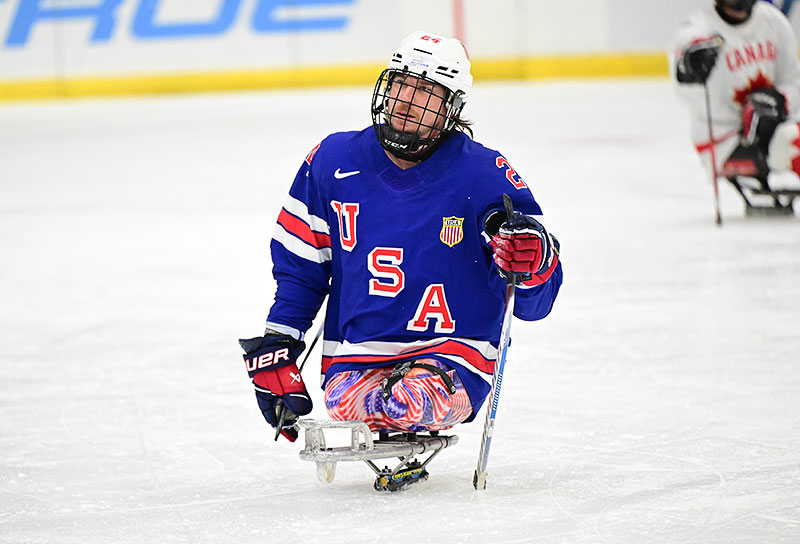
From an early age, hockey was Josh Misiewicz’s passion. He started playing roller hockey in the street outside of his La Grange home and was soon putting on skates and hitting the ice. He played for the Lyons Township High School team and as well as St. Mary’s University in Minnesota. “I just loved the sport,” he says. “It was hockey or nothing—there was no other sport for me.”
After two years of college, Misiewicz enlisted in the U.S. Marine Corps in 2010. He was deployed to Afghanistan in 2011 as a machine gunner, and on July 20 of that year he was injured by an improvised explosive device while on patrol, which led to the loss of both of his legs.
He had assumed his hockey career was over, but while rehabilitating at Walter Reed Hospital in Maryland, he discovered sled hockey, which allows people without the use of their legs to play. Misiewicz soon found that not only did it help with his rehab, but it also kept his passion for hockey alive. His dedication to the sport led him to make the U.S. National Team, and he was part of the gold-medal-winning squads at the 2018 Paralympics in PyeongChang and the 2022 Paralympics in Beijing. He’s back with the team this year to compete March 6 to 15 at the Paralympic Games in Milan, where the American sled hockey team will try to bring home its fifth straight gold.

Q: Was there ever a question about trying to play in your third games?
A: No, it was something I knew I wanted to do. I’m honored to play for this team, and I’m happy I made the team—that wasn’t a given. It’s a very competitive sport. There are a lot of guys right on the edge of this team, and that’s a tough decision to make each year. It’s a tough competition, for sure. Nothing is given to you.
Q: For someone who hasn’t seen sled hockey, how do you describe it?
A: They’re pretty much the same rules as standup hockey. The big difference is that we play with a left and right stick, and we have metal picks at the end of our sticks to propel ourselves on the sled. So we have to shoot and skate with our hands. It takes some getting used to.
Q: How did you discover the sport?
A: At Walter Reed, I met someone who played on the USA Warriors sled hockey team. He knew I liked hockey—I’m from Illinois, he was from Wisconsin—and he got me out on the ice to try it. It was difficult, but I knew that I would love it from the second I got back into a rink.
Q: Did it help with your recovery?
A: One of my first thoughts [after the injury] was that I’ll never play hockey again. Getting to continue participating in the sport was important to me, and now that I can play at the Paralympic level, it is the best thing ever.
Q: What are you looking forward to most at the Paralympics this year?
A: In 2022, we couldn’t have our families there because of COVID. That makes a huge difference in the experience. I can’t wait for them to be there with us. We don’t really get to see them a ton because your focus is on hockey, but having them in the stands supporting us is a huge boost.
Q: Is Canada your biggest rival this year?
A: It’s become very competitive. Eight teams qualified, and I’d say all eight have a shot. Canada isn’t in our bracket, so we may not even play them. Nothing is assured. We’ve had a lot of success in the past, so I think it’s easy for people to assume that we’ll do well, but we aren’t looking at it that way. We know the sport has grown, and the competition is getting better every year.
Q: What do people tell you surprises them most about watching sled hockey?
A: It’s full contact! That’s one of the parts I love about it. The speed and physicality of it are going to blow your mind if you’ve never seen it before.
Photos: USA Hockey
