


Peeks At the Past
By Jen Banowetz
View more Community
The DuPage County Historical Museum hosts three new exhibitions
Covering the gamut from local veterans to Route 66, a trio of new temporary exhibitions are now open at the DuPage County Historical Museum (102 E. Wesley St., Wheaton). “Each year we try to make all of our temporary exhibits share a common theme,” says Emily O’Brien, museum curator. “That doesn’t mean they all cover the exact same topics, but rather that there is a common thread connecting them and allowing visitors to engage with each exhibit more intentionally.”
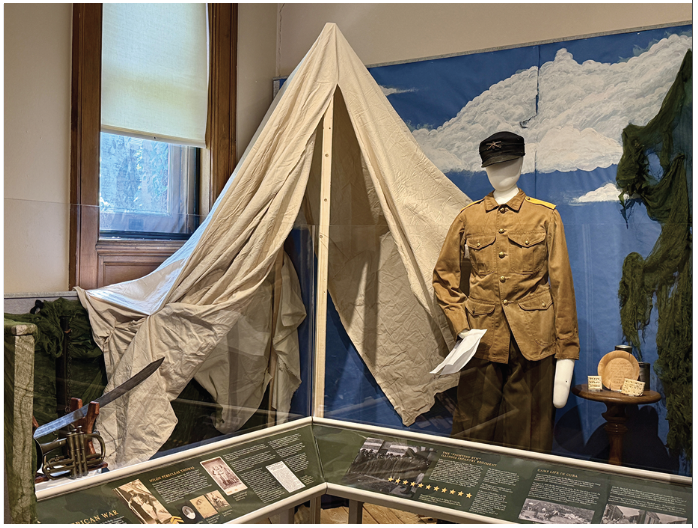
This year’s theme is “DuPage Identified,” with each exhibition exploring ways DuPage County residents have expressed their identities. Take Serving With Honor: DuPage County Veterans (running through March 20), which showcases local service members. One of O’Brien’s favorite parts of that exhibition is not necessarily an artifact but a story.

“We were able to take a deeper look into the life of Solon P. Thomas, a Black Wheaton resident who served during the Spanish-American War, and tell his story on a much more personal level than we’re normally able to,” she says. “We recreated one of the photographs in our collection by using an exhibit case to build a small diorama of him at one of his military camps. We were also able to reconnect with the donor of his artifacts, who turned out to be a distant relative of Solon, making the experience even more meaningful.”

Defining US: The 250th Anniversary of the United States (running through April 10), meanwhile, commemorates America’s semiquincentennial. “The content explores the various events and time periods throughout American history, but the artifacts themselves tell the stories of how local residents lived through and responded to those moments,” O’Brien explains.
One such artifact is a Bible on loan from the Elmhurst History Museum that belonged to Prescott Talbot, an Elmhurst resident who carried it during the Civil War. “The Bible contains an inscription describing its importance to him during that time and offers insight into how he may have relied on it for comfort during wartime,” O’Brien says.
She also enjoyed networking with other organizations. “What I loved most was being able to reach out to historical museums across the county and borrow artifacts that offered perspectives I wouldn’t have been able to include on my own,” she says. “Those contributions helped make the exhibit feel more diverse and relatable, especially for visitors who don’t often see their own communities represented.”

The third temporary exhibition, The Mother Road & Iconic DuPage Firsts (running through Nov. 14), showcases Route 66’s 100th anniversary while also marking several notable firsts in DuPage County, such as the first 18-hole golf course (Chicago Golf Club in Wheaton), the first rails-to-trails conversion (Illinois Prairie Path), and the first shot fired at Gettysburg (by Marcellus Jones, who went on to serve as DuPage County sheriff and Wheaton postmaster). “These are all points of pride for DuPage and Illinois and highlight why so many residents are proud to call DuPage County home,” O’Brien says. Created in collaboration with the DuPage Convention & Visitors Bureau, the exhibition was guest curated by museum staff member Beth Frederick and volunteer Dan Swick.
“The main thing I hope visitors experience is being able to see themselves in some way within our exhibits,” O’Brien says. “That connection can happen in many different ways, whether it’s recognizing a familiar place, relating to someone’s personal story, or simply experiencing the joy of learning more about a topic they’re interested in.”
Of course, putting together any exhibition comes with its own obstacles. “One common challenge across all of them is finding the personal stories behind the artifacts we display,” O’Brien says. “We always want to tell more than just the story of an event or time period—we want to tell the story of the person who owned or used the object. Unfortunately, unless a donor provides that information, those stories can be very difficult to uncover, which can make the curatorial process especially challenging.”
Presenting history takes plenty of planning. The museum sets its exhibition schedule about five years in advance. “This gives us plenty of time to develop themes, create logos and exhibit descriptions, begin marketing, and eventually start the research and development process,” O’Brien says.
Preliminary research starts a few years before an exhibit actually debuts. “About a year and a half before opening, we really begin designing the exhibit, writing labels, selecting artifacts, and finalizing the layout,” she says. “Installation typically takes anywhere from two to four weeks, depending on the size and complexity of the exhibit.”
Each exhibition is displayed for about nine to 12 months before making room for the next one.
O’Brien believes preserving history is important because it allows us to continue sharing it. “History is the foundation of today—it has shaped who we are and helps inform the decisions we make,” she says. “Without preserving and sharing these local stories, we begin to lose the sense of community that ties people together. Local history gives people the opportunity to reflect on the past, better understand the present, and make informed decisions about the future.”
For more information, visit dupagemuseum.org.
Accessories After the Fact
Opening Sept. 12 and running through May 29, 2027, the DuPage Historical Museum’s newest exhibition is Out of the Box: History from Head to Toe, which showcases how accessories and fashion trends were used as ways for residents to express themselves. Think hats, shoes, jewelry, outerwear, fans, parasols, and purses—many of which were owned and worn by DuPage County residents.
“One of my favorite things about History from Head to Toe is how immersive it feels, even though it isn’t a hands-on exhibit,” says Emily O’Brien, museum curator. “We’re intentionally designing the exhibit space to resemble a vintage downtown storefront, using inspiration from photographs of shoppers in downtown areas during the early 20th century. Rather than simply looking at display cases, visitors will feel as though they’re window shopping, creating a more engaging and memorable experience.”
