


10 Trends in Education
By Naperville Magazine
View more Featured
How local K-12 schools are adapting and innovating
By Jeff Banowetz
Illustrations by Ryan Snook
How to teach the next generation has always caused much debate. Educators must determine how to integrate the latest technology into the classroom, and there isn’t an easy solution. But that isn’t the only trend changing the look of schools. A greater focus on hands-on learning, multilingual programs, new activities, and more inclusive learning environments are all influencing education to keep up with an evolving world. Here are 10 prominent trends to watch.
1. Girls’ Flag Football Takes Off
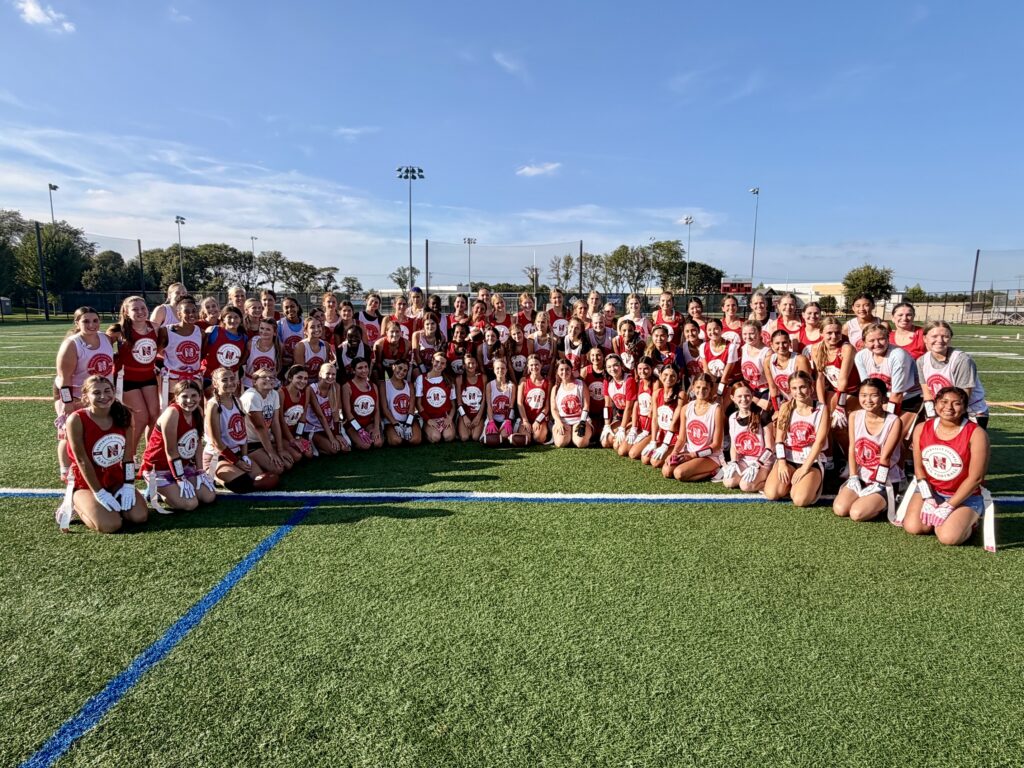
In 2024 the Illinois High School Association recognized girls’ flag football for the first time, with about 150 schools fielding teams in the inaugural season. Last year that number rose to 250 schools, and the sport is scoring great interest in the western suburbs.
Caroline Schwartz was named head coach of Naperville Central’s first girls’ flag football team last year, and she led the squad to a 16–4 inaugural season and district championship. She founded Lane Tech’s flag football program in 2022 (and won a state championship in 2023) before moving on to Benedictine University, where she also continues to coach that college program.
“Growth across Illinois has been unprecedented,” she says. “I absolutely expect more schools to add programs. Districts across the state are seeing the direct benefits, high participation rates, strong student engagement, minimal startup barriers relative to contact football, and tremendous community support.”
She had no problem finding girls to play in Naperville Central’s first season. “The interest right out of the gate was phenomenal,” she says. “We had 50 girls come out, allowing us to field a varsity and junior varsity team immediately.
“This season we had 80 girls turn out for tryouts, which enabled us to expand our program to three full teams,” Schwartz says. “Having a full year of competition under our belt, a regional championship title, and strong community word-of-mouth has made flag football a premier athletic choice at Naperville Central rather than just a secondary option.”
At Naperville Central, the sport, which plays during the fall season, attracted athletes who’d previously played basketball, track, soccer, and volleyball, as well as those participating in a high school sport for the first time. “It highlights raw athleticism, route running, spatial awareness, footwork, and quick decision-making,” she says. “Its explosive growth comes down to a combination of high inclusivity, where athletes of all backgrounds find specialized roles, alongside strong support from the NFL and local community organizations that have legitimized the sport. Its inclusion in the 2028 Summer Olympics and expanding collegiate scholarship pathways give young women clear, long-term athletic goals to strive toward.”
As for the 2026 season, Schwartz hopes to “build on the standard of last year” and continue to grow the sport across the state. “We are aiming to continue to foster a team culture where veteran leaders mentor our underclassmen to ensure long-term success across all three program levels.”
2. More Multilingual Programs
While the western suburbs have experienced an influx of immigrants from around the world, schools have increased support for these students through additional programs. For example, according to Rafael Segarra, director of Multilingual Learning Programs at Indian Prairie School District 204, about 41 percent of its students come from homes where a language other than English is spoken. Students in the district speak more than 129 different languages. An increase in students from Russia and Ukraine (a total of 383 this year) has made Russian the second most popular native language (after Spanish) for students in the district.
The latest information available from District 204 states that 15.8 percent of its 26,000 students are learning English as a second language. That’s up from just 2.5 percent during the 2005-2006 school year.
These numbers align with the national trend. According to the National Center for Education Statistics, the number of English learners in schools rose steadily over the last two decades (with a slight dip during COVID) and is now more than 10 percent of students overall.
Naperville District 203 is in the final phase of a three-year implementation of bringing its multilingual services to all schools in the district. According to District 203, there are 71 languages represented by students. The top five are Spanish, Mandarin, Russian, Urdu, and Hindi. The number of students taking advantage of the program is up more than 70 percent since 2013.
In some District 203 schools where more than 20 students speak the same second language, schools provide some instruction in the students’ native language while those students also learn English.
Those who speak a language of fewer than 20 other students in a school generally receive English as a Second Language (ESL) support, which includes some co-teaching models in elementary school.
3. Phasing Out Phones
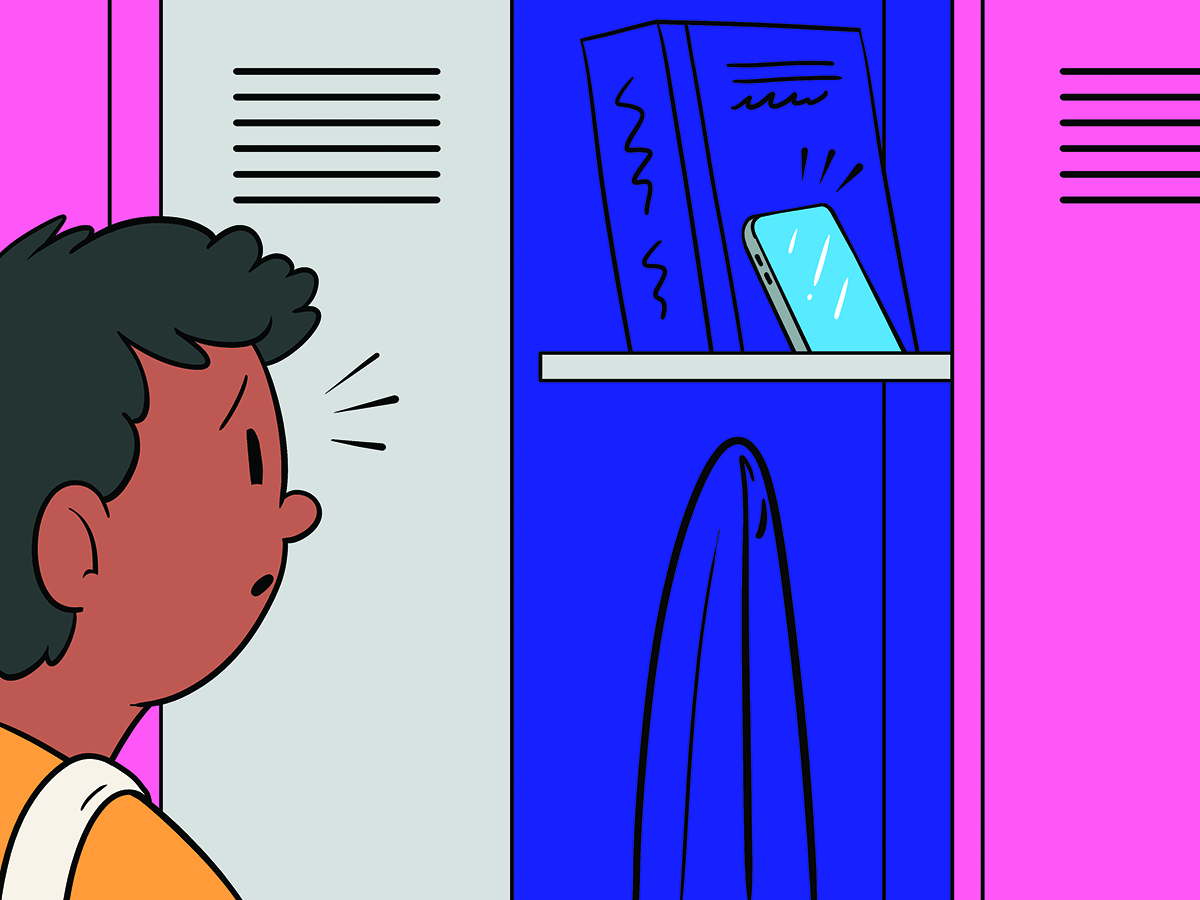
Schools struggle with the same problem as the rest of society—how to take advantage of advances in technology while curbing their downsides. The debate over students’ cellphone use has been one of the fastest-changing policy issues in the country, with concerns growing that children, particularly at the middle- and high-school levels, spend more and more time looking at their phones instead of interacting with friends and peers.
While schools have often limited the use of phones during classroom work, in 2023 Florida was the first state to adopt what has been labeled “bell-to-bell” prohibition of cellphones. Since then, many states have followed with laws that don’t allow students any access to their phones for the entire school day—including Illinois when Governor JB Pritzker signed a bill in July to enact the statewide law, which will starting with the 2027–28 school year. As he said at the bill’s signing ceremony this summer: “Illinois is taking a major step forward in creating classrooms, libraries, and learning environments free from distractions by banning the use of cellphones during the school day. We are ensuring every hour of the school day has the greatest possible positive impact, allowing every child to fully learn, participate, ask questions, and build the skills and interpersonal relationships they need to thrive.”
The law will prohibit all cellphone use during the school day for grades K to 8, while Illinois high schools will be permitted to craft their own rules allowing students to continue using phones during passing periods or lunch.
Most school districts in the area already restrict cellphone use in some way, but the policies vary greatly by district or school. Illinois will be offering a template to school districts this fall to help them create a phones-in-school policy that aligns with the ban. Still, you can expect this to remain a hot-button issue as districts decide how to develop their own policies for their high schools.
4. Project-Based Learning Programs
More schools are discovering that students can learn more by putting knowledge to work in the real world. The move toward project-based learning is particularly strong in the STEM fields, and a good example is the Project Lead the Way curriculum, which has been instituted at many schools in the area.
This national organization has created a template for learning from pre-K through high school that emphasizes “activity-, project- and problem-based instructional design that centers on hands-on, real-world activities and problems that help students understand how the knowledge and skills they develop in the classroom can be applied to everyday life.”
Some aspects of the program include encouraging students to work collaboratively and design their own solutions to problems. A teacher is there to help, but they’re encouraged to find their own way through experimentation and brainstorming. The focus is more on problem-solving and creating results than on following a teacher’s instructions.
Jennifer Krzak, who teaches the Lead the Way program at Jefferson Junior High School in Naperville, was named Teacher of the Year by the Technology Education Association of Illinois for her work with the program. Jefferson uses the Gateway to Technology curriculum, which looks to engage middle schoolers as they design and test their ideas using computer modeling software. The curriculum “creates a strong foundation for further STEM learning in high school and beyond,” Krzak says.
5. STEM Competitions
Perhaps you competed in a spelling bee during your school days? While the Scripps National Spelling Bee is still going strong (in fact, District 204 student Shruthi Ayyagari made it to the national finals in 2025), there are many more academic contests these days. The STEM fields, in particular, have developed many national competitions, often outside the structure of a classroom.
For example, the Conrad Challenge, named after astronaut Pete Conrad, is a global competition that recognizes what it calls the “next generation of world-changing entrepreneurs.” It has had several Naperville-area winners over the last few years, including this year, when the team from Neuqua Valley High School, which called itself VOCL, won the top prize in the cybertechnology and security category. Students Idhant Ranjan, Atharva Vaze, James Zhou, Craig de Fiesta, and Jayden Chiou created a product to help those who struggle with speech. Their LLM-powered headset can detect changes in facial muscles, allowing people to communicate in real time via an audible voice.
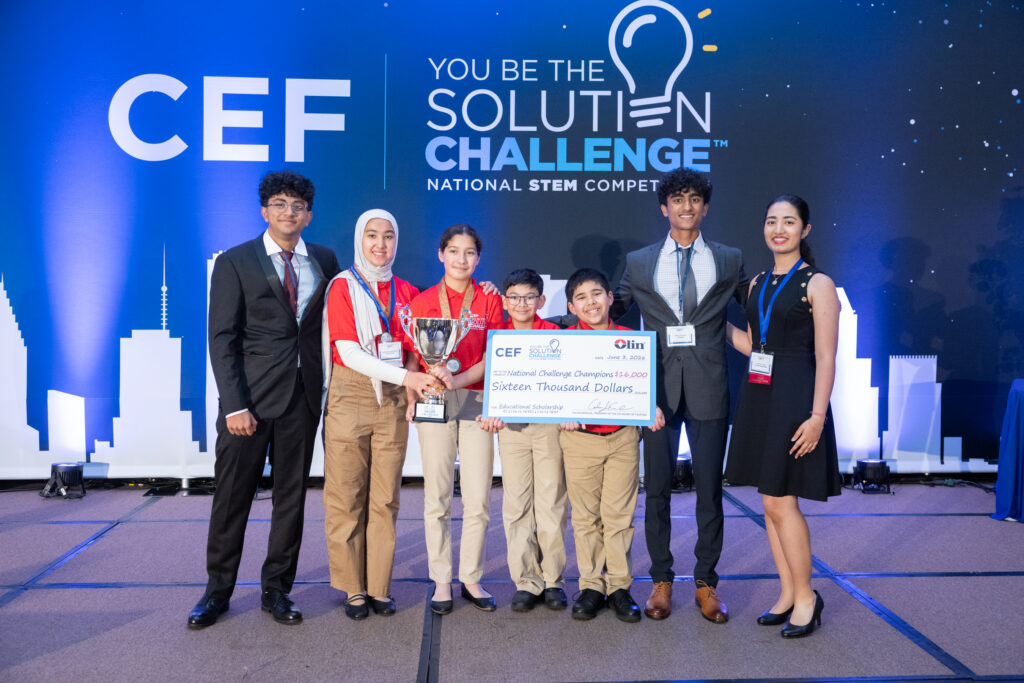
Other local winners this year came from the Creating Exciting Futures in STEM “You Be the Solution Challenge.” The winning team included two Naperville students, seventh graders AbduRahman Yuldash, a student at Kennedy Junior High School and Umar Kandimov from Scullen Middle School along with high school freshman team members Saliha Nurmukhamedova from Walter Payton College Prep and Nasima Zair from the Illinois Math & Science Academy. They created a product to help people with dental hygiene. Their reusable mouth guard is filled with a hydrogel. When you put it in your mouth, it reacts with plaque, turning purple to show where plaque is located on the teeth. A sensor sends the information to a PlaqueTracker app they created to help you better track your progress. The team won a $16,000 scholarship for their victory.
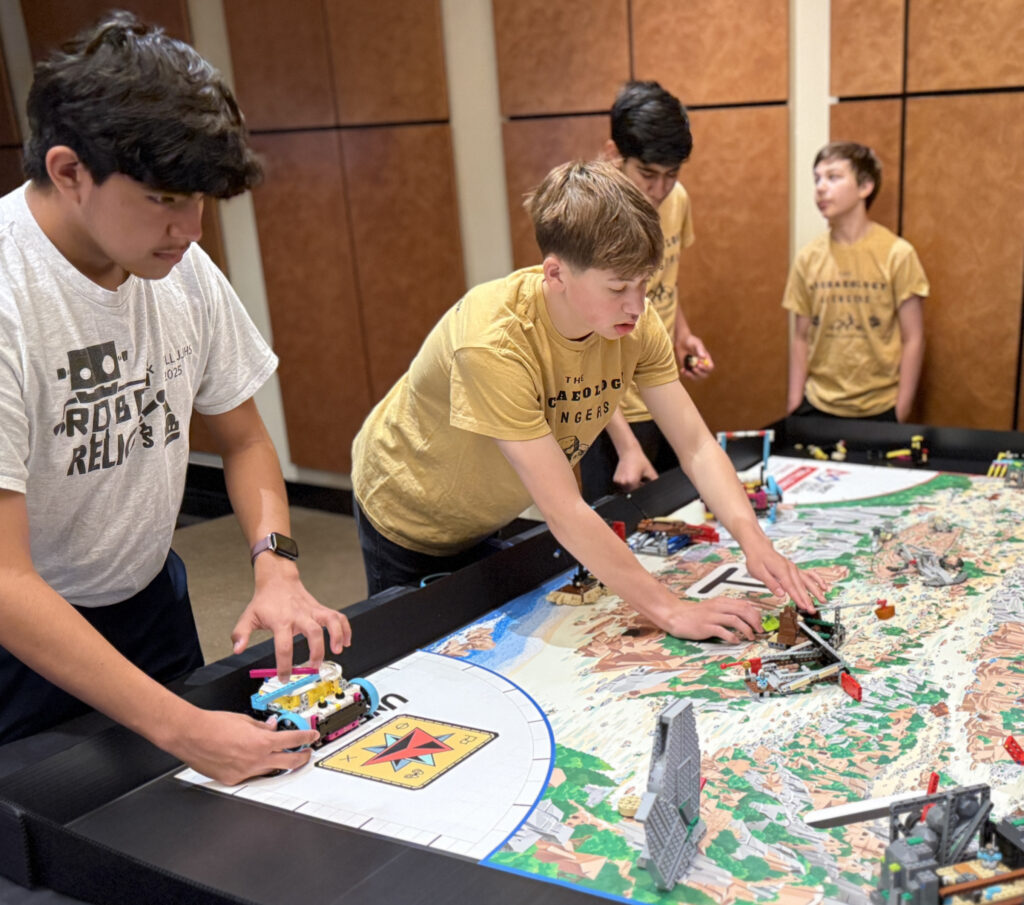
The rise of these STEM-related events—from First Lego League robot-building battles (a program at all 14 Naperville elementary schools and five middle schools) to the Illinois Envirothon (a team competition in which students are tested on environmental topics like forestry, aquatic ecology, and wildlife)—brings many science-based activities out of the classroom into a more entertaining atmosphere, while the teamwork aspect helps strengthen social skills.

6. Changes in How Schools are Rated
In a ratings-obsessed society, it’s understandable that people want an easy metric to determine how well schools serve their children. Of course, it’s also understandably difficult to measure something as complicated as a school by a single number. This year, the Illinois State Board of Education is changing how public schools are tracked and rated, with a new system it hopes will make “school ratings clearer and fairer.” (You can find a school’s current grade at illinoisreportcard.com.)
The new system no longer grades schools on a curve. In the past, a school was rated against other schools rather than by specific criteria. This meant a school’s rating could fluctuate each year even if it were producing the same results. The new rating system uses fixed standards to determine a school’s rating.
The previous rating system used four categories for ranking: exemplary, commendable, targeted, and comprehensive, with the bottom two categories requiring state intervention. Almost 75 percent of all schools fell into the “commendable” category, but there was a significant difference between those at the top and bottom of that group. The new rating system keeps exemplary at the top and comprehensive at the bottom but now has three categories in the middle—approaching exemplary, commendable, and developing. (It’s expected that only 25 percent of high schools will now be ranked commendable.)
There are a few other changes to the metrics as well, such as how much a school is dinged for chronically absent students (not as much), but the overall grading system hasn’t undergone significant changes. According to the Illinois State Board of Education, just over half of all Illinois public school students can read at grade level, while 39 percent achieved grade-level proficiency in math.

7. Greater Focus on CTE Programs
After decades of intense focus on preparing students for college, schools are expanding options to those who want to take a different path toward their careers. CTE programs—Career Technical Education—are receiving increased state funding and offering high school students opportunities to pursue education in high-demand trades.
The Illinois Association of School Boards cites a significant shortage of skilled labor across several categories requiring specialized certification or training, including healthcare, automotive, welding, and machining. Its report suggests that “investing in CTE programs is an investment in student success and economic growth, offering substantial returns on investment for individuals and communities.” It also reported that students who completed two or more CTE classes had a 9 to 14 percent greater likelihood of graduating from high school.
“We’re doing a better job of asking students, ‘What are you interested and passionate about?’” says Mike Fumagalli, executive director of the Technology Center of DuPage in Addison, which partners with all the public high schools in the county. It offers 17 different programs for high school juniors and seniors, including automotive technology, criminal justice, emergency medicine, HVAC and residential wiring, and professional cooking. Students can earn dual credits for high school and college.
“You’ll see a career center full of young people who are really excited and passionate and interested about what they’re doing,” Fumagalli says. “We’re building towards something pretty amazing.”
8. Real-Life Business Training
The sciences aren’t the only areas of education highlighting real-world experience. Most area high schools have started business incubator programs over the last decade or so, and they’ve become a very popular way for students to get business training by coming up with their own products, working with mentors to create prototypes, and pitching to investors via a Shark Tank–style competition.
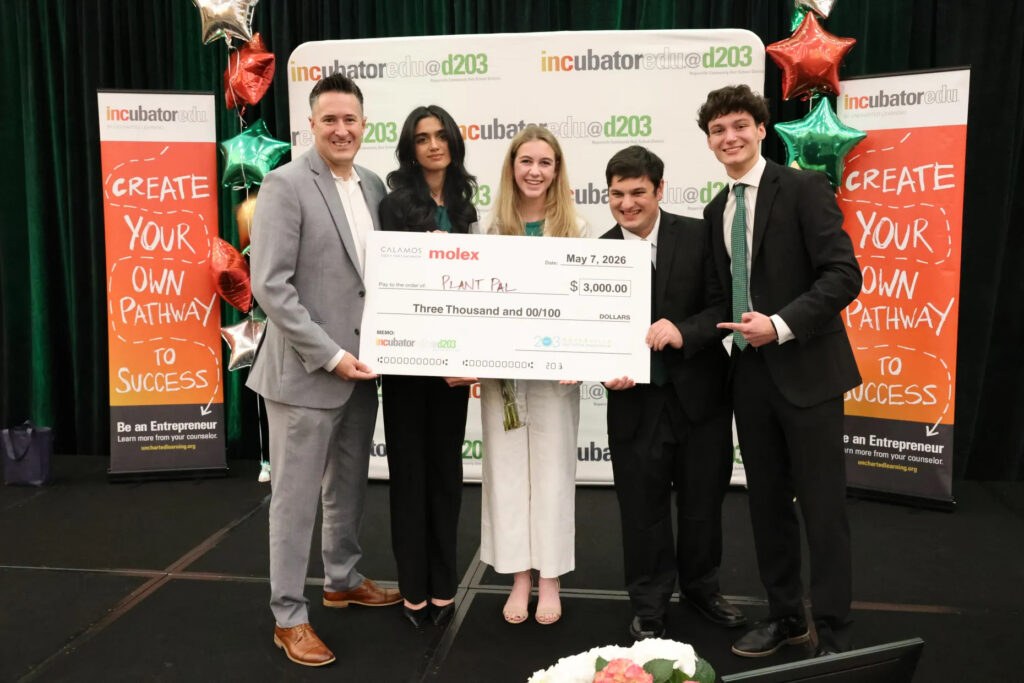
Naperville District 203 hosts an annual pitch night where the top teams from Naperville North and Naperville Central compete for the $3,000 prize in seed funding for their products.
This year’s winners from Naperville Central created the Plant Pal, a self-watering tool for houseplants. The team of Katelyn Burke, Jack Swigert, Ben Reed, and Mahika Solanki was not only named the top team at pitch night, but it was also one of just five teams chosen from more than 60 nationwide to present their product at the INCubatoredu National Pitch contest in Chicago this summer.

9. AI in Classrooms
The elephant in the room at practically every school in the country is artificial intelligence. The disruptive technology has caused a radical change for both students and teachers as they adapt to a world in which AI can be both a useful tool and a way to avoid the necessary work of learning.
As District 203 states on its policy page, AI “has the power to expand access to information and enhance learning opportunities for all students. As this technology shapes the future, we are responsible for preparing our students to thrive and create in an AI-driven world.” But it also mentions the downsides, highlighting its academic integrity policy, which states that “students are expected to submit work that accurately represents their own knowledge and skills, and the use of AI in place of original work is only permitted when specifically authorized by staff.”
Students may learn to use AI, but in doing so they may not develop other skills that come from learning through traditional methods. A study this year by the Brookings Institution’s Center for Universal Education found that AI can “undermine children’s foundational development.” According to the report: “After interviews, focus groups, and consultations with over 500 students, teachers, parents, education leaders, and technologists across 50 countries, a close review of over 400 studies, and a Delphi panel, we find that at this point in its trajectory, the risks of utilizing generative AI in children’s education overshadow its benefits.”
While that study got a lot of attention, others countered that if students don’t learn how to use AI responsibly, they will not be adequately prepared for a future in which it is likely to be a big part of almost every job. It’s also probably unrealistic to expect students not to use it on their own, even if it isn’t part of classroom training.
The debate will undoubtedly continue as school districts struggle with how to balance both concerns.
10. What Can we Learn from Mississippi?
In 2013, the state of Mississippi, the poorest in the nation, ranked 49th in the country for fourth-grade literacy when it started a new statewide program that emphasized changes in both how reading was taught and how schools and students were held accountable for results. Most controversially, it emphasized having students repeat the third grade until they could meet the reading standard.
What happened over the next decade astounded just about everyone outside the state. Reading (and math) scores in the state jumped substantially—at a time when they were falling in most other states—and Mississippi now ranks in the top 10 for fourth-grade literacy. According to the Urban Institute’s demographically adjusted performance measure, the state ranks No. 1 overall.
Dubbed by many as the “Mississippi Miracle,” it led to a deluge of studies, op-eds, and reflections by educators to help determine how it was done. The answer, of course, is complicated. Some aspects of the Mississippi program, such as a greater emphasis on phonics, more support for teachers, and better efforts to reach struggling readers in the early grades, have been touted. Other states that have implemented similar programs also have found success (though not to the same extent as Mississippi). Still, it has forced the educational establishment to pay attention to what has happened in the state and hopefully yield solutions that can be applied across the country.
Photos: ScottyD Photography (Naperville Central Girls’ Flag football); District 203 (CEF Winners); Jen Banowetz (First Lego League); Jeff Banowetz (TCD); District 203 (pitch night)
